Exploring the Collection of Diverse Modern Web Isometr: A Practical Guide for Designers and Developers
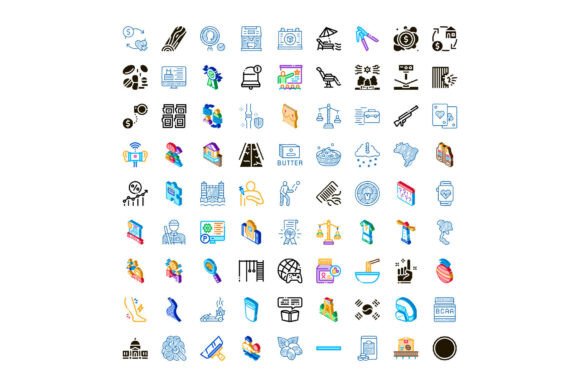
Designing a visually engaging and functionally effective digital interface often hinges on the quality and variety of graphic elements used. The Collection of Diverse Modern Web Isometr stands out as a valuable resource for web and application developers seeking a wide range of icons that convey complex ideas through clean, isometric visuals. Unlike standard icon sets that rely on flat or minimalist styles, this collection embraces a three-dimensional aesthetic that adds depth and realism without compromising usability.
Isometric design, characterized by its 30-degree angled perspective, has gained popularity in digital interfaces due to its ability to present information in a more spatially intuitive way. The Collection of Diverse Modern Web Isometr leverages this style to represent a broad spectrum of concepts—from business analytics and data security to user interaction and cloud computing—making it particularly useful for dashboards, infographics, and technical applications.
What Makes the Collection of Diverse Modern Web Isometr Unique?
While many icon libraries offer a variety of themes and categories, the Collection of Diverse Modern Web Isometr distinguishes itself through its emphasis on spatial representation and thematic diversity. Each icon is crafted with a consistent visual language that ensures seamless integration across different platforms and layouts. This consistency, paired with a rich visual vocabulary, makes it easier for designers to maintain coherence in complex UI environments.
Another notable feature is the collection's scalability. Whether used in a mobile app or a large-scale web dashboard, the isometric icons retain clarity and detail at various resolutions. This adaptability is particularly beneficial for responsive design, where visual elements must adjust to different screen sizes without losing their communicative power.
Comparing Isometric Icons with Other Styles
When evaluating icon styles, it's important to consider how isometric designs compare to other commonly used formats such as flat, glyph, or line icons. Flat icons are known for their simplicity and minimalism, which can be ideal for clean, modern interfaces. However, they often lack the depth needed to represent more complex ideas. Glyph icons, typically monochromatic and symbolic, are great for universal recognition but may not offer the visual richness that some projects demand.
In contrast, the Collection of Diverse Modern Web Isometr provides a middle ground—offering visual depth without being overly detailed. This makes it a strong choice for applications where context and spatial relationships matter, such as educational tools, architectural visualizations, or data-heavy platforms. However, for projects that prioritize speed and minimal resource usage, simpler icon formats may be more appropriate.
Strengths and Tradeoffs of Using Isometric Icons
One of the primary strengths of the Collection of Diverse Modern Web Isometr lies in its ability to convey multi-layered information through a single visual element. For example, an isometric icon representing a logistics network can show different components—warehouses, trucks, and delivery routes—in a single, cohesive image. This level of detail can enhance user understanding and engagement, especially in professional or technical contexts.
However, this visual richness comes with tradeoffs. Isometric icons are generally more complex than their flat or glyph counterparts, which can affect performance in resource-constrained environments. Additionally, their three-dimensional nature may not align with every brand's visual identity, particularly those that favor a minimalist or ultra-modern aesthetic.
When to Choose the Collection of Diverse Modern Web Isometr
The Collection of Diverse Modern Web Isometr is particularly well-suited for projects that benefit from visual storytelling and spatial clarity. If your application or website needs to illustrate processes, systems, or environments in an intuitive and engaging way, isometric icons can provide a significant advantage.
For instance, a project management tool might use these icons to depict workflows, team roles, or task dependencies more clearly than a flat icon could. Similarly, a financial dashboard could use isometric visuals to represent investment portfolios, market trends, or risk factors in a way that's both informative and visually compelling.
When Another Option Might Be Better
Despite its strengths, the Collection of Diverse Modern Web Isometr may not be the best fit for every scenario. In cases where simplicity and speed are top priorities, such as mobile apps with limited processing power or minimalist websites aiming for a sleek appearance, a more streamlined icon format may be preferable.
Additionally, if your design system already relies on a specific visual language that doesn't incorporate depth or perspective, integrating isometric icons could create inconsistency. In such cases, it's often better to choose a style that aligns with your existing design principles, even if it means forgoing some of the expressive capabilities of isometric graphics.
Practical Considerations for Implementation
When incorporating the Collection of Diverse Modern Web Isometr into a design project, it's important to evaluate both technical and aesthetic factors. From a technical standpoint, ensure that the icons are available in scalable vector formats (such as SVG) to maintain quality across devices and resolutions. Also, consider the file size and rendering performance, especially if your project includes a large number of icons or runs on lower-end devices.
Aesthetically, it's crucial to test how the icons integrate with your overall UI/UX design. This includes checking for color harmony, visual balance, and alignment with your brand identity. Many design teams find it helpful to create a style guide that outlines how isometric icons should be used in different contexts to ensure consistency across the platform.
Real-World Examples and Use Cases
- E-learning platforms: An online course management system might use isometric icons to represent different learning modules, progress tracking, or instructor roles in a visually engaging way.
- Healthcare dashboards: A medical data visualization tool could leverage these icons to illustrate patient flows, treatment plans, or hospital infrastructure with clarity and depth.
- Tech startups: A SaaS product aimed at project managers might use isometric visuals to depict timelines, team collaboration, and workflow automation.
These examples demonstrate how the Collection of Diverse Modern Web Isometr can enhance user experience by making abstract or complex concepts more tangible and intuitive.
Making an Informed Design Choice
Ultimately, the decision to use the Collection of Diverse Modern Web Isometr depends on your project's specific needs, target audience, and design goals. If you're aiming for a visually rich, context-aware interface that communicates complex ideas effectively, this collection can be a powerful asset. However, if your priorities lean toward minimalism, performance, or brand consistency, exploring alternative icon styles may be the better path.
As with any design decision, the key is to evaluate options based on how well they serve the end user. By understanding the strengths and limitations of isometric iconography—and how it compares to other styles—you can make a more informed choice that aligns with your project's vision and functional requirements.